





Introduction
Watch whether redness, itching, pain, or swelling after a GLP‑1 injection improves or gets worse. Local itching or redness can occur with semaglutide (Ozempic, Wegovy) or tirzepatide (Mounjaro, Zepbound), but spreading pain or swelling needs assessment. Trouble breathing, swelling of the face or throat, or fainting requires emergency help. 1 2 3 4
Make note of any injection site reaction
Look at the location and extent of the reaction. Note whether you have an itchy patch, a bruise, tenderness, or a raised area. Record when you first noticed it and whether it remains close to the puncture site.
Researchers combined results from two Zepbound weight-management trials. In those trials, adults with overweight or obesity, with or without type 2 diabetes, received weekly injections for up to 72 weeks. Injection-site reactions occurred in 6% of participants taking 5 mg, 8% taking 10 mg, and 8% taking 15 mg, compared with 2% taking placebo. The category included itching, redness, pain, and bruising. Do not use these figures to decide how long to wait before getting help for a worsening reaction. 4
A small area that is improving is different from swelling that expands with increasing pain. Contact your clinician if a reaction persists, recurs, or worries you, even without emergency symptoms. For a raised area, see our guide to lumps after injection.
Record what changed for your clinician
Use a consistent description rather than “bad reaction.” You could write: “itchy patch around the right thigh injection, noticed that evening, smaller the next morning.” A photo taken in similar lighting can help you compare appearances and show your care team what you saw.
Include the medication and dose, exact site, and any device problem. Note a recent dose change, a new skin product, or a bandage over the area without assuming one caused the reaction. Record symptoms elsewhere on your body too.
Do not use an app’s severity score to decide whether you need care. Describe what you feel and how it affects you. Your clinician may need to examine the area rather than make a decision from a photograph.
Recognize infection and allergy warning signs
Seek prompt medical assessment for spreading redness, increasing warmth or pain, pus, fever, or red streaks. A clinician may need to check for a skin infection or a pocket of pus called an abscess. Do not wait for an arbitrary number of days if the area is worsening. 5
Call emergency services for breathing or swallowing difficulty, face or throat swelling, or fainting. These can indicate a serious allergic reaction. Stop using the medication and seek immediate medical help; do not take another dose until your treating clinician advises you. 1 2 3 4
Choose unaffected skin for the next injection
General subcutaneous injection guidance advises avoiding damaged, bruised, swollen, or red skin. Review site rotation and follow the diagram for your exact device. Ask your care team before reusing a spot with a persistent reaction. 6
For a drop of blood after a Mounjaro single-dose pen injection, Lilly advises pressing with cotton or gauze without rubbing. If discomfort continues, ask your pharmacist about suitable care rather than trying a new cream or antihistamine without checking. 7
Device technique needs its own review. Follow your device’s instructions for preparing the injection and checking that it is complete. Hold times differ between devices. If fluid escaped, use our leakage guide and seek advice before any extra dose.
Track reactions with Shotsy
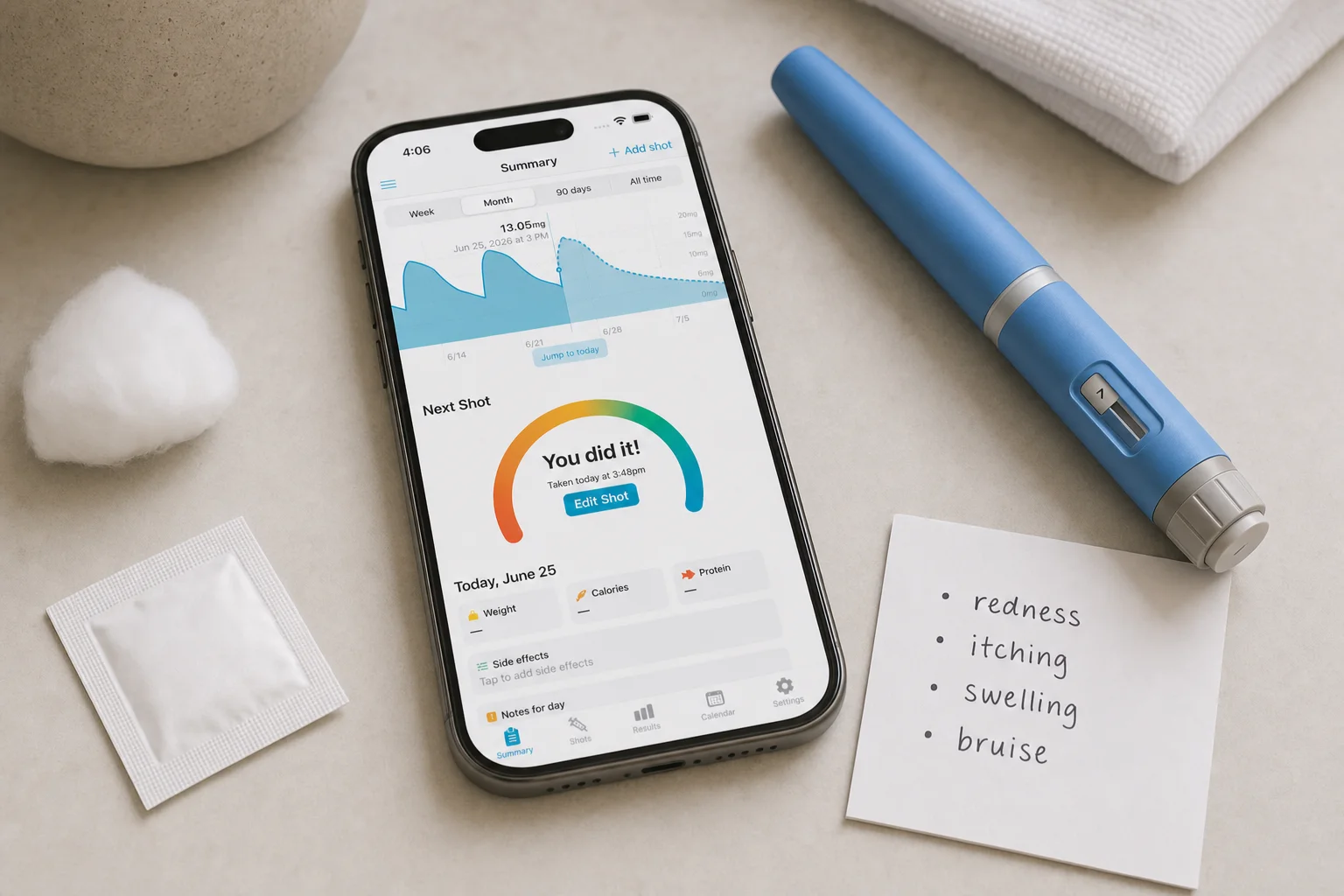
Record your injection site and symptoms alongside each dose in Shotsy. With Shotsy you can export a PDF that includes a side effects chart to see how your symptoms improve or worsen over time. Bring it to your appointment or send it to your provider, along with notes about where the reaction appeared and how it changed.
Conclusion
If you notice a reaction after an injection, record when it started and whether it is improving. Contact your clinician if it keeps returning or does not improve, and seek prompt care for spreading redness, increasing pain, or fever. Before your next injection, choose an unaffected spot within an approved injection area and ask your care team about any reaction that concerns you.
This post is intended for informational purposes only and is not a substitute for professional medical advice. Always consult your physician before making any changes to your medication or health routine.