





Introduction
Women taking GLP‑1 medications are increasingly reporting changes to their menstrual cycles, heavier periods, irregular timing, breakthrough bleeding, and in some cases, unexpected pregnancies. A 2026 medRxiv study analyzing posts from 67,008 Reddit users flagged menstrual irregularities as an emerging signal associated with GLP‑1 receptor agonist use. While clinical trial data on menstrual outcomes is limited, the biological mechanisms connecting weight loss to hormonal shifts are well established. Understanding these connections helps you identify changes worth discussing with your provider.
What women are reporting
The conversation around GLP‑1 medications and menstrual changes has grown rapidly in online communities and clinical settings. The most commonly described changes include:
- Heavier or longer periods: Some women report periods that are significantly heavier than baseline, particularly during the first three to six months of treatment.
- Irregular cycle timing: Cycles that were previously predictable may become shorter, longer, or inconsistent in length.
- Breakthrough bleeding: Spotting between periods, especially during dose escalation phases.
- Return of periods: Women who had stopped menstruating due to PCOS-related anovulation report their periods returning after starting treatment.
- Increased fertility: Multiple anecdotal reports describe unplanned pregnancies in women who believed they were infertile or had low fertility due to PCOS or age-related factors.
The 2026 medRxiv study used natural language processing to analyze discussion patterns across GLP‑1 subreddits. Menstrual irregularities emerged as a statistically significant signal that had not been prominently captured in original clinical trial adverse event reporting.
The biology connecting weight loss to cycle changes
Menstrual changes on GLP‑1 medications are not random. They are driven by well-understood biological pathways:
- Fat tissue and estrogen production: Adipose (fat) tissue produces estrogen through aromatase activity. When you lose a significant amount of body fat, your total estrogen production changes. This can alter the hormonal balance that regulates your menstrual cycle, leading to changes in cycle length, flow volume, and ovulation patterns.
- PCOS and ovulation restoration: For women with polycystic ovary syndrome, weight loss of just 5 to 10 percent of body weight can restore regular ovulation. GLP‑1 medications frequently produce weight loss well beyond that threshold, meaning women who had not been ovulating may begin doing so again, sometimes without realizing it.
- Caloric restriction and hypothalamic disruption: Rapid weight loss and significant caloric restriction can independently disrupt the hypothalamic-pituitary-ovarian axis. When caloric intake drops below what the body considers safe for reproduction, the brain may reduce or halt the hormonal signals that drive menstruation. This is the same mechanism behind exercise-induced amenorrhea.
- Leptin changes: Leptin, a hormone produced by fat cells, plays a role in reproductive signaling. Rapid reductions in body fat cause leptin levels to drop, which can disrupt the pulsatile release of GnRH (gonadotropin-releasing hormone) and downstream reproductive hormones.
GLP‑1 medications and contraceptive effectiveness
An important safety consideration has emerged regarding tirzepatide and oral contraceptives. The prescribing information for Mounjaro and Zepbound notes that tirzepatide may reduce the absorption of oral contraceptive pills during dose escalation periods. The mechanism is the delayed gastric emptying that slows absorption of oral medications.
Eli Lilly’s guidance recommends that patients using oral hormonal contraceptives either switch to a non-oral method (such as an IUD, implant, patch, or ring) or use a backup barrier method during dose escalation and for four weeks after reaching a maintenance dose.
This does not apply to non-oral contraceptives. IUDs, implants, injections, patches, and vaginal rings are not affected by changes in gastric emptying. If you are taking an oral contraceptive and starting or titrating tirzepatide, discuss this with your prescriber before your next dose increase.
Semaglutide (Ozempic, Wegovy) has not shown the same interaction in studies, but the underlying mechanism of delayed gastric emptying is shared. Some providers recommend similar caution as a precaution.
Unexpected fertility and pregnancy risk
The combination of restored ovulation and potentially reduced oral contraceptive effectiveness creates a real pregnancy risk that many women are unaware of. This is especially relevant for women with PCOS who may have been told they would have difficulty conceiving.
If you are of reproductive age and taking a GLP‑1 medication:
- Use reliable contraception: If pregnancy is not desired, ensure your method is not solely dependent on oral absorption. Discuss options with your OB/GYN.
- Discontinue before conception: Both semaglutide and tirzepatide should be stopped at least two months before a planned pregnancy. Animal studies have shown reproductive toxicity, and there is insufficient human safety data during pregnancy.
- Report a positive test immediately: If you become pregnant while on a GLP‑1 medication, contact your prescriber right away. The medication should be discontinued, and your pregnancy should be monitored closely.
When to talk to your provider
Menstrual changes on GLP‑1 medications are common enough that they warrant a conversation with your provider, but they are not always a sign of a problem. Contact your OB/GYN or prescriber if you experience bleeding that soaks through a pad or tampon in under an hour, periods lasting longer than seven days, no period for three or more consecutive months when not expected, severe cramping that is new or worsening, or any possibility of unintended pregnancy.
Your provider can evaluate whether the changes are an expected effect of weight loss and hormonal shifts or whether further workup is needed.
Track cycle changes with Shotsy
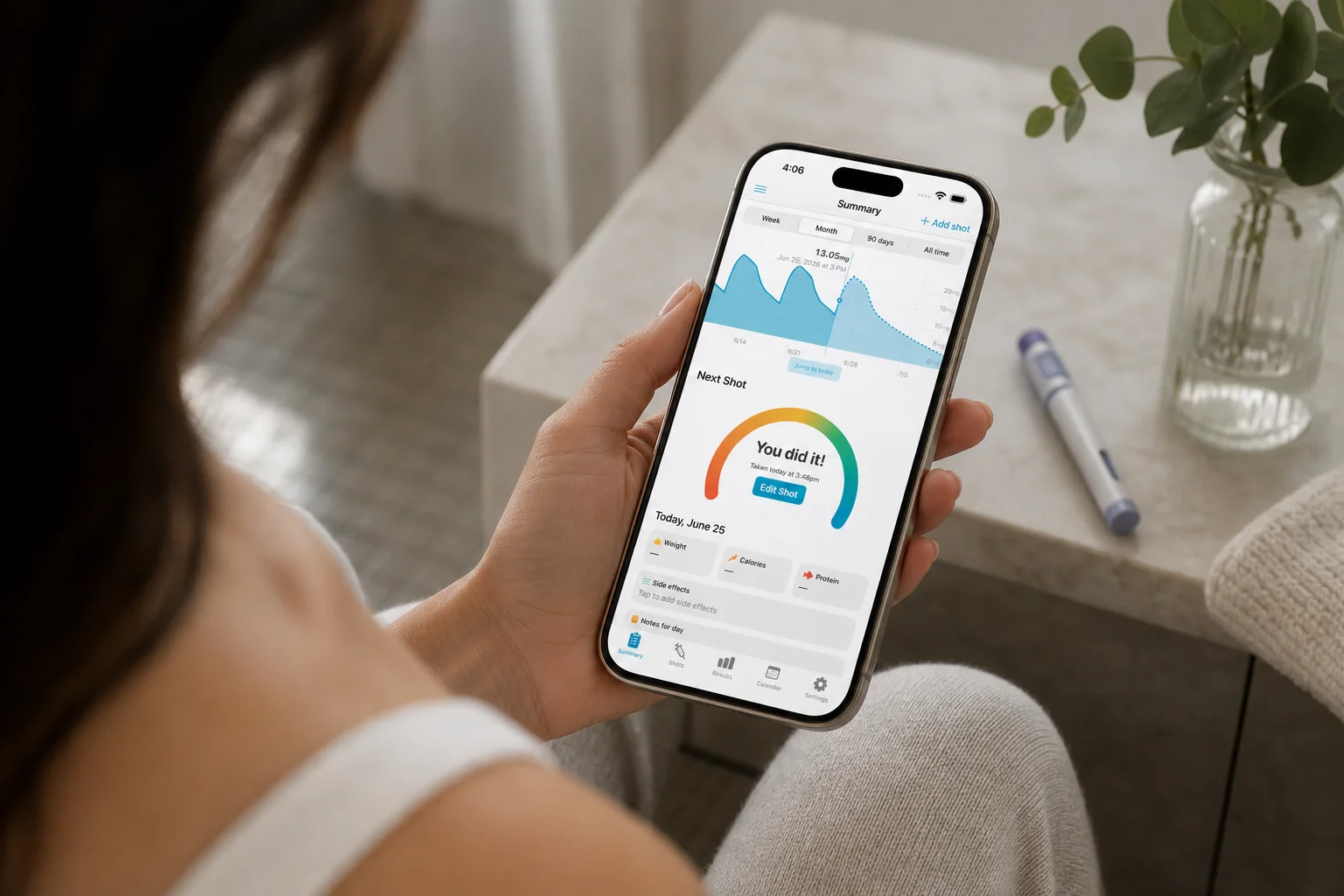
Use Shotsy’s daily notes to log your cycle start date, flow changes, spotting, and any related symptoms each day. Over several months, this creates a detailed timeline of how your menstrual patterns have shifted alongside your weight loss and dose changes. Export this data as a PDF to share with your OB/GYN, a visual timeline is far more useful than trying to remember dates from memory.
Conclusion
Menstrual changes on GLP‑1 medications are a real and underreported phenomenon. They are driven by the hormonal shifts that accompany rapid weight loss, including changes in estrogen production, leptin signaling, and, for women with PCOS, the restoration of ovulation. Tirzepatide may also reduce oral contraceptive absorption during dose escalation. If you notice changes to your cycle, log them consistently and bring the data to your provider. These conversations are easier and more productive when you have a clear record of what changed and when.
This post is intended for informational purposes only and is not a substitute for professional medical advice. Always consult your physician before making any changes to your medication or health routine.