





Introduction
If your scale has not moved in weeks despite staying on your GLP‑1 medication, you are not alone. Weight loss plateaus affect the vast majority of people taking semaglutide (Ozempic, Wegovy) or tirzepatide (Mounjaro, Zepbound), and they are a normal, physiologically expected part of treatment rather than a sign that your medication has stopped working. This article explains why plateaus happen, what the clinical data actually says, and five practical steps you can take to break through.
Why plateaus happen on GLP‑1 medications
A GLP‑1 weight loss plateau occurs when your body reaches a new equilibrium between energy intake and expenditure. Three main mechanisms drive this:
- Metabolic adaptation: As you lose weight, your resting metabolic rate drops. Your smaller body simply burns fewer calories at rest than it did at a higher weight.
- Set point resistance: Your body defends against further weight loss through hormonal shifts, including changes in leptin, ghrelin, and insulin sensitivity, that increase hunger and slow metabolism.
- Receptor desensitization: Over time, GLP‑1 receptors may become less responsive to consistent drug exposure, reducing the appetite-suppressing effect.
In clinical trials, the weight loss curve is not a straight line. In STEP 1 (semaglutide 2.4 mg, 1,961 participants), most weight loss occurred by weeks 30 to 40, with the curve flattening after that. In SURMOUNT-1 (tirzepatide 15 mg, 2,539 participants), the plateau emerged around weeks 36 to 44. By week 72, 87 to 90 percent of participants across BMI categories had reached a plateau interval.
When plateaus typically start
The timing depends on your medication:
- Semaglutide (Ozempic, Wegovy): Plateaus typically occur at 6 to 12 months, with average total weight loss of 15 to 20 percent of starting body weight.
- Tirzepatide (Mounjaro, Zepbound): Plateaus tend to arrive later, at 9 to 15 months, with average total weight loss of 20 to 25 percent.
- Orforglipron (Foundayo): Early data suggests plateaus at 6 to 10 months, with 14 to 17 percent weight loss in maintenance trials.
A stall at week 8 or 12 is almost certainly not a true plateau. It is more likely related to titration timing, dietary drift, or body recomposition where you are gaining muscle while losing fat.
Five steps to break through
Before assuming your medication has failed, work through this evidence-based protocol:
- Audit your protein: Track your intake for three days. The target is 1.2 to 1.6 grams per kilogram of body weight daily. Inadequate protein accelerates muscle loss, which lowers your metabolic rate and stalls progress.
- Add resistance training: Two to three sessions per week targeting major muscle groups is the single most evidence-supported intervention for protecting your metabolism during a plateau. Even bodyweight exercises count.
- Check your sleep: Consistently sleeping fewer than seven hours disrupts appetite hormones and increases cortisol. Fix this before adjusting anything pharmacological.
- Increase fiber: If you are under 25 grams per day, add five grams per day each week until you reach the target. Fiber supports satiety and gut health.
- Give it four more weeks: Plateaus often break on their own once your body settles into a new equilibrium. If weight and measurements have not budged after eight or more weeks at a stable dose, bring your data to your provider.
When to talk to your provider about a medication change
If you have completed the steps above and your weight has been stable for eight or more weeks at your maximum tolerated dose, it is time for a clinical conversation. In the SURMOUNT-5 trial, tirzepatide produced 47 percent greater weight loss than semaglutide in a head-to-head comparison. For patients who have plateaued on maximum-dose semaglutide, switching to tirzepatide is the most evidence-backed next step. Weight loss often restarts within four to eight weeks of switching. Your provider may also consider dose optimization, combination approaches, or ruling out underlying factors like thyroid dysfunction.
Track your plateau with Shotsy
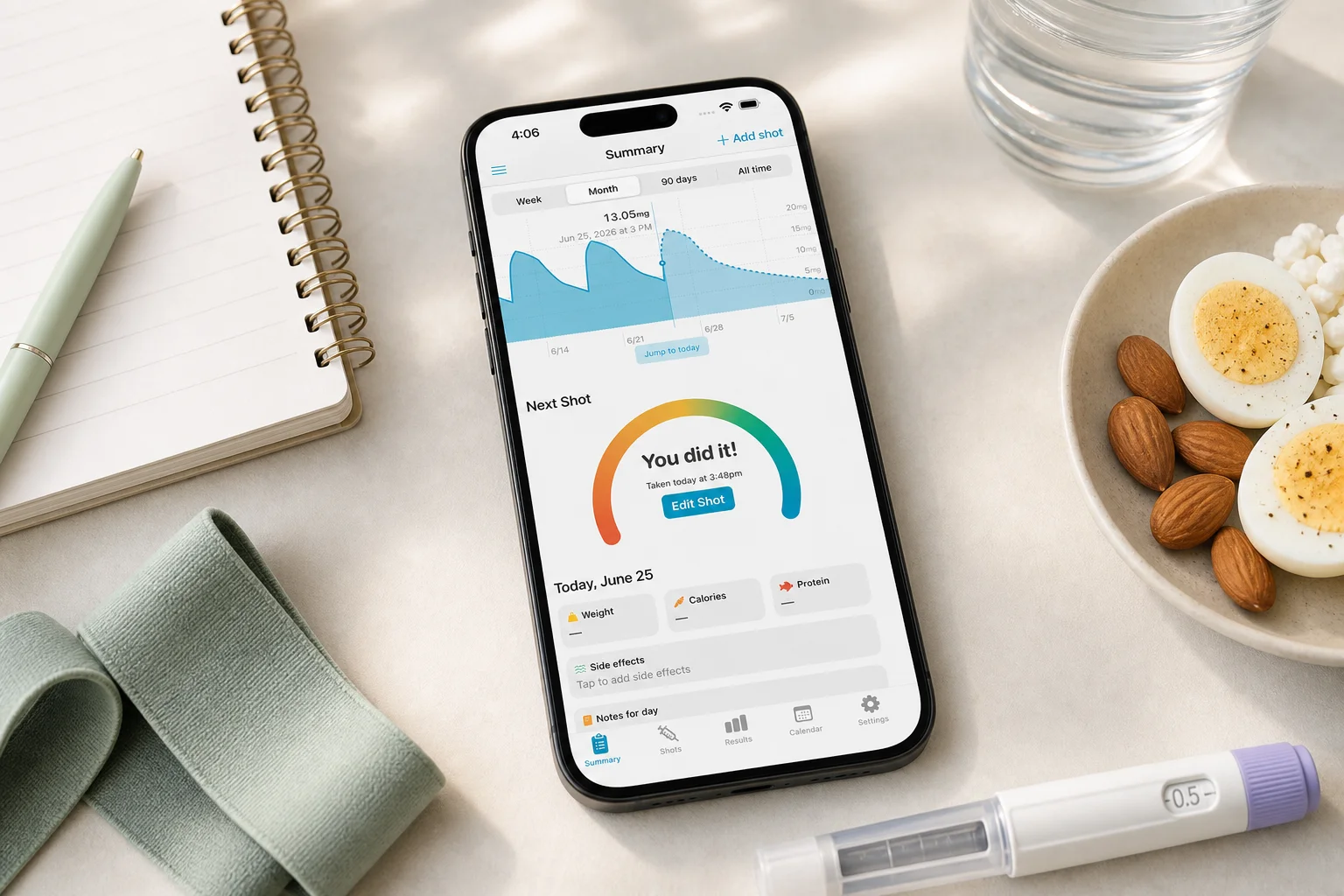
Shotsy’s weight trend charts and dosage stats help you distinguish a true plateau from normal fluctuation. Track daily protein and calories to catch nutrition drift, then export a PDF summary showing your dose history alongside your weight trend for your next provider visit.
Conclusion
A GLP‑1 weight loss plateau is not a failure. It is your body adapting to a lower weight, and clinical trials confirm that nearly everyone experiences one. Focus on protein, resistance training, and sleep before making medication changes, and bring your tracking data to your provider so decisions are guided by evidence rather than frustration.
This post is intended for informational purposes only and is not a substitute for professional medical advice. Always consult your physician before making any changes to your medication or health routine.